Lal Kitab
Lal Kitab Planets
Each planet analysed through the Lal Kitab system rashi placement, exalted/debilitated/friend/enemy position, benefic or malefic nature, and sleeping (Soya) status.
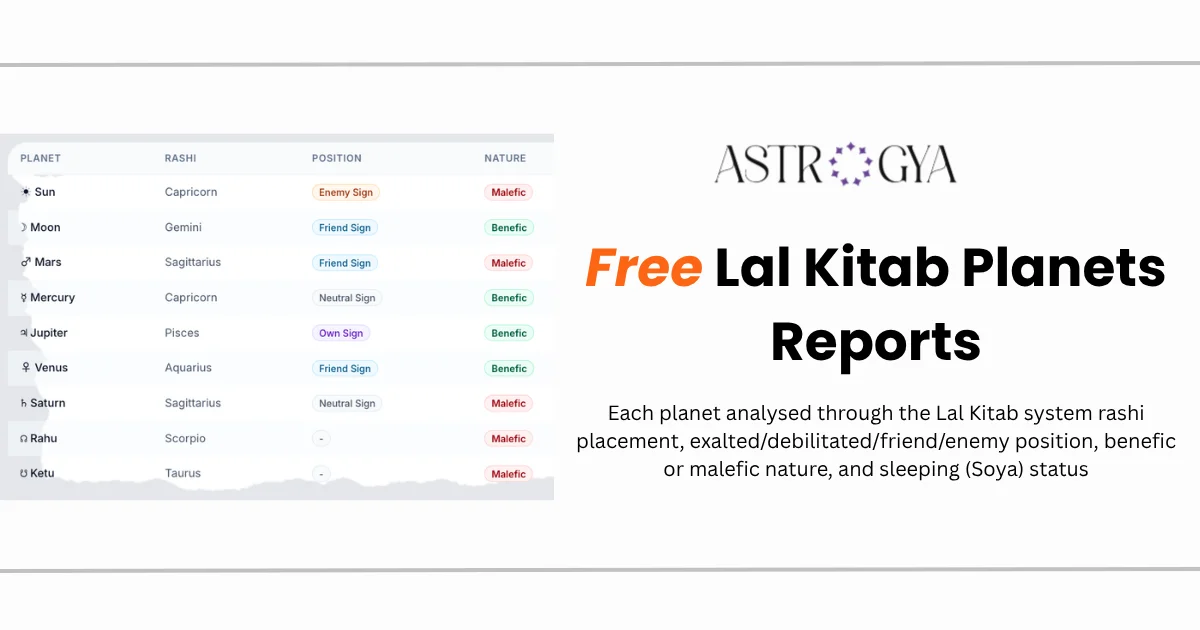
What Are Lal Kitab Planets and How They Work
Lal Kitab treats planets as active agents whose behaviour depends heavily on the house they occupy, not just their inherent nature. A planet that is considered naturally good can still cause trouble if placed in an environment that disturbs its function, and similarly a harsh planet can become more manageable when it lands in supportive ground.
This is what separates Lal Kitab planet analysis from generic astrology summaries. The method is more practical, more result-oriented, and far more sensitive to the specific life area where a planet is sitting.
Understanding this is the starting point for reading any Lal Kitab planets by house result correctly.
Difference Between Lal Kitab and Vedic Planet Analysis
Standard Vedic astrology gives strong importance to sign dignity, house lordship, divisional charts, aspects, and dasha sequences. Lal Kitab also uses house and sign data, but its core question is different — it asks how a planet is behaving inside that house, not just what it owns or rules.
The guest-in-a-house analogy is often used in Lal Kitab texts to explain this. A guest behaves according to the environment they have entered, and results follow from that interaction. This is why a Lal Kitab planet's reading should always be treated as its own system, separate from the standard birth chart interpretation even when the same planetary positions are used.
Nine Planets and Their Role in Lal Kitab
Each of the nine grahas carries a fixed set of significations in Lal Kitab that stay consistent across charts.
| Planet | Core Significations in Lal Kitab |
|---|---|
| Sun | Authority, father, self-respect, name, government, vitality |
| Moon | Mind, mother, adaptability, emotional peace, domestic life |
| Mars | Action, courage, property, blood, disputes, physical strength |
| Mercury | Speech, intelligence, trade, calculation, skill, adaptability |
| Jupiter | Wisdom, children, blessings, ethics, guidance, dharma |
| Venus | Marriage, comforts, beauty, desire, vehicles, sensual life |
| Saturn | Karma, labor, delay, discipline, endurance, justice |
| Rahu | Ambition, illusion, foreign patterns, obsession, sudden rise |
| Ketu | Detachment, sharp karma, breaks, intuition, inner clearing |
How to Read Your Lal Kitab Planets Report on Astrogya
Your report gives you each planet with five key data points: sign, house, degree, speed, and status. Reading them together gives a complete picture; reading only one of them in isolation will almost always lead to a wrong conclusion.
The recommended reading order is: house first, then sign, then status (benefic or malefic), then check if it is sleeping or active.
| Field | What It Shows | How to Use It |
|---|---|---|
| Sign | Which rashi the planet occupies | Tells you planetary temperament and dignity level |
| House | Life area where the planet is active | The primary lens in Lal Kitab reading |
| Degree | Exact numerical position within the sign | Helps assess strength and proximity to sign boundaries |
| Speed | Rate of movement, including retrograde | Negative speed values indicate retrograde or unusual motion |
Benefic vs Malefic Planets in Your Lal Kitab Chart
A benefic planet in your chart signals support, protection, ease, or positive results in the relevant life area. A malefic marker does not necessarily mean permanent damage — it flags the need for awareness, because that planet is more likely to create pressure, conflict, delay, or a karmic test in the house it occupies.
The important thing is to not read benefic or malefic as fixed labels for the whole life. A malefic placed away from sensitive houses may give very little trouble at all. Context always determines strength in Lal Kitab, and that is why no single field in your report should be read alone.
Exalted, Debilitated, Friend and Enemy Status
These four markers reflect how well a planet can express itself within the sign it occupies.
- •Exalted (Ucch): Planet is in its strongest sign, able to function at a high level.
- •Debilitated (Neech): Planet is in its most uncomfortable sign, may underperform or give strained results.
- •Friend Sign: A reasonably supportive environment, the planet operates without major friction.
- •Enemy Sign: Planet is in a sign that creates internal resistance, may give inconsistent or conflicted results.
But here is the thing — a debilitated planet in a highly supportive house does not always fail. The status creates a tendency, and the house environment either worsens or softens it. In Lal Kitab, both factors carry weight.
Sleeping (Soya) vs Active Planets – What It Really Means
A sleeping planet, or soya grah, is present in the chart and occupying a house, but its results are not fully expressed in real life. The planet's promise exists in theory but stays dormant until some trigger — a dasha period, transit, major life event, or corrective action — activates it.
A sleeping benefic can mean unused potential: you may have the talent, connection, or resource, but it does not show up until the right moment arrives. A sleeping malefic is often quieter than expected, but once activated it can surface strongly.
When your report marks a planet as sleeping, do not panic and do not ignore it. Read it as a timing question, not a permanent condition.
Planet-Wise Lal Kitab Meanings and Effects (Overview)
The interpretations below show broad Lal Kitab behaviour patterns for each planet. These are not house-by-house breakdowns — your personalised report inside the tool handles that. This section is meant to help you understand what a planet fundamentally brings into the houses it occupies.
Sun in Lal Kitab
Sun governs self-respect, authority, father relationship, government connections, and social recognition. When it functions well, it gives a clear identity, visible confidence, and ability to lead or hold position. An afflicted Sun often shows up as ego problems, distance from father, status instability, or poor confidence in key moments.
Moon in Lal Kitab
Moon in Lal Kitab represents the emotional body, mental peace, mother's influence, and ability to adapt to life circumstances. Its condition in the chart often reflects how calm or restless the inner life feels day to day. Disturbed Moon can produce mood swings, lack of inner peace, troubled home environment, or dependency on external emotional validation.
Mars in Lal Kitab
Mars rules action, courage, physical energy, property matters, and decisive movement. In Lal Kitab, a healthy Mars placement is considered protective — it gives the chart a spine. Afflicted Mars tends to create impulsive decisions, disputes, verbal aggression, accidents, or domestic friction.
Mercury in Lal Kitab
Mercury rules speech, intelligence, commercial instinct, calculation, and flexible adaptability. It does best where mental agility and clear communication decide outcomes. Afflicted Mercury can produce communication failures, overthinking, business misjudgment, nervous tension, or inconsistency in decisions.
Jupiter in Lal Kitab
Jupiter signifies wisdom, blessings, children, spiritual guidance, ethics, and rightful expansion. When placed well, Jupiter brings a quiet protection to the chart that the native often takes for granted. An afflicted Jupiter may delay children-related matters, reduce wisdom in key decisions, or weaken the native's ability to receive genuine guidance.
Venus in Lal Kitab
Venus governs love, marriage, sensory pleasure, vehicles, comforts, and the quality of one's relational life. It is one of the most watched planets for both relationship outcomes and material enjoyment. Afflicted Venus commonly shows marriage friction, financial indulgence without peace, vanity, or emotional dissatisfaction in relationships.
Saturn in Lal Kitab
Saturn represents karma, labor, patience, realism, and the principle of delayed but fair reward. In Lal Kitab, Saturn is never read as pure suffering; in the right placement it becomes the most stabilising force in the chart. Afflicted Saturn tends to cause delay, fear, social isolation, career obstacles, and a long feeling of effort without visible progress.
Rahu in Lal Kitab
Rahu amplifies worldly desire, creates unconventional life patterns, and pushes toward unusual ambition. Its results are rarely neutral — it either gives sharply or disturbs sharply, depending on its house and support. Afflicted Rahu can produce scandal, confusion about life direction, greed, hidden anxiety, or image-building without substance.
Ketu in Lal Kitab
Ketu brings detachment, karmic correction, precision, inner sharpness, and a tendency to cut what has served its purpose. It functions as a silent but powerful planet whose results often go unnoticed until something is suddenly gone. Afflicted Ketu may show strange separations, withdrawal, misunderstood intentions, lack of consistent confidence, or chronic sense of incompleteness.
When to Upgrade to a Detailed Lal Kitab Report
The free Lal Kitab planets tool is a solid first step. It gives you placement, condition, and sleeping status for all major grahas. But it does not give you timing, yearly prediction, or the layered interpretation that comes from combining planets across houses.
You may need the full report if:
- •Multiple malefic planets are active in key houses like the 1st, 7th, or 10th.
- •You are going through a major life transition — career shift, marriage, health concern, or relocation.
- •Your chart shows strong placements on paper but real life feels blocked or delayed.
- •You want year-specific Lal Kitab guidance, not just a static snapshot.
FAQs on Lal Kitab Planets
Q. Is this Lal Kitab planets tool completely free?
Yes. The Lal Kitab planets analysis on this page is fully free, requires no registration, and gives instant results after you enter your birth details.
Q. What if I don't know my exact birth time?
You can still use the tool. Planetary sign and degree data will be accurate, but house placement may shift slightly.
Q. What does "sleeping planet" mean in practice?
A sleeping or soya planet is present in your chart but not actively delivering its full results. This can mean delayed outcomes, muted expression, or a life area that feels stuck — and it often changes once the right dasha period or life event triggers it.
Q. Can sleeping (soya) planets become active later in life?
Yes, they can and often do. Certain dasha periods, transits, marriages, relocations, or even conscious corrective actions can activate a sleeping planet.
Q. Is Lal Kitab planets analysis accurate for everyone?
Lal Kitab gives better results when the birth time is accurate and when the reading is done in context — not by isolating one planet or one house.
Q. Are Lal Kitab remedies mandatory if a planet is malefic?
No. A malefic marker signals tendency, not certainty. Many charts carry malefic planets in key houses and still produce strong, productive lives.
Q. Do Lal Kitab planets change over time?
Natal positions are fixed at birth and do not change. What changes is which planets become active or sleeping based on dasha timing and transits. That is why the same chart can feel very different in different phases of life.