Monthly Calendar
Panchang Calendar
A full month's Panchang at a glance Tithi, Nakshatra, and festival indicators for every date. Select any month and your location.
Date
Friday, 8 May 2026
Location
28.6139°N · 77.2090°E · UTC+5.5
Loading data…
Your Daily Vedic Almanac
Panchang Calendar -- Today's Tithi, Nakshatra, Festivals & Planetary Chart
Astrogya's Panchang Calendar is designed to feel like the living almanac many of us grew up with, just moved into a clean digital space you can check any time. It brings today's detailed Panchang and a full monthly Hindu calendar together in one free tool, so you can see tithi, nakshatra, vrats, festivals, sunrise, sunset, and even a simple planetary chart without opening multiple apps or books.
Location-based Panchang that adjusts by latitude, longitude and timezone, so you are always seeing the sky for your actual city.
Full daily details: tithi, paksha, nakshatra, yoga, karana, weekday (vaar), vrats, festivals, sunrise, sunset, moonrise, moonset and Rahu Kaal.
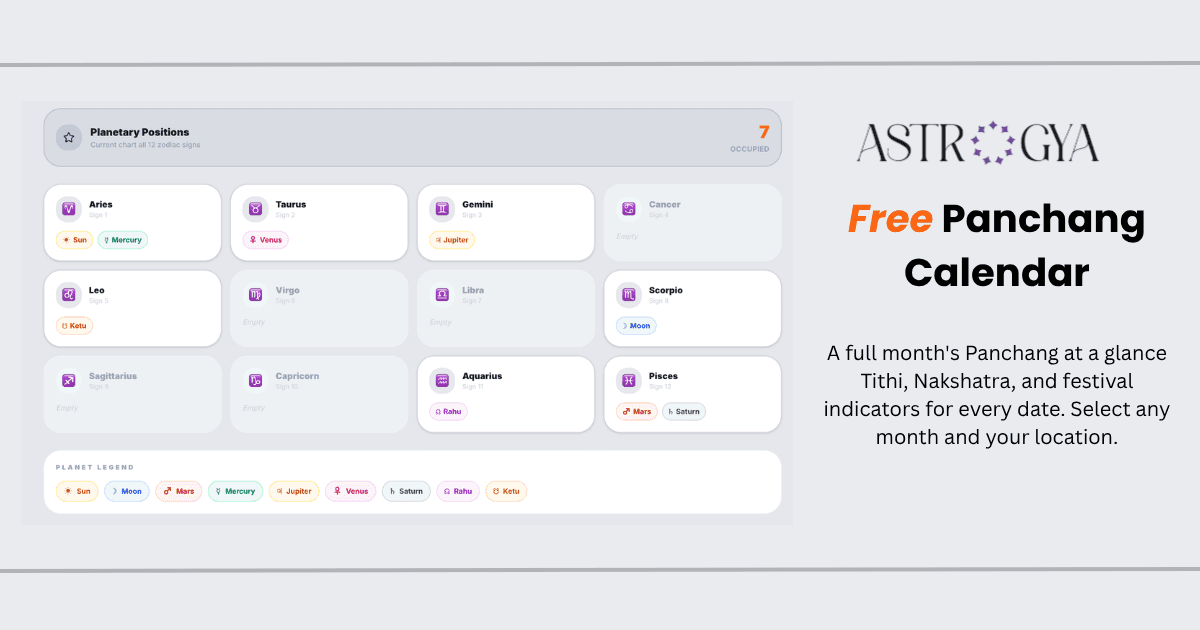
A unique “Planetary Panchang” snapshot that shows which planets are in which rashis today, adding a quick transit view to the traditional five limbs.
Free access from any device, making it easy to build a daily spiritual rhythm without paying for basic calendar data.
A gentle blend of traditional calculations with a modern interface, drawing inspiration from respected Panchang sources while staying simple to use.
Today's Panchang Calendar (Location-Based)
When I read Panchang for clients, the first correction I often make is location; a few degrees of latitude can change tithi or nakshatra at a key moment. Astrogya's "Today's Panchang" is always calculated for your chosen city, so you're working with true local time, not a generic chart.
1
Uses your latitude, longitude and timezone to compute sunrise, sunset and Moon position accurately for that place.
2
Lets you auto-detect location or manually select your city, which helps if you’re travelling or reading Panchang for a family member elsewhere.
3
Follows the Panchang day from sunrise to next sunrise (not midnight to midnight), aligning festival and vrata rules with classical practice.
4
Captures subtle shifts: a small change in sunrise or moonrise can move a tithi or nakshatra off a key puja time, especially on Ekadashi, Purnima, Amavasya or Sankranti.
5
Keeps all this calculation behind the scenes so you simply see “Today’s Panchang” as if an experienced pandit had prepared it for your city.
Daily Snapshot
Today's Panchang Card
When you open the Panchang page, you're greeted with a "Today's Panchang Card" that summarises the day's sacred climate at a glance. This is the card I'd tell you to check first each morning, before you dive into all the finer details.
Typical elements on the card include:
Gregorian date and weekday, so you can match it with your regular calendar.
Hindu date with lunar month, paksha and tithi (for example: “Chaitra, Shukla Paksha, Dashami”).
Today’s nakshatra, yoga, karana and the Moon’s rashi (sign), which together colour the emotional and karmic tone of the day.
Sunrise, sunset, moonrise, moonset and Rahu Kaal, with optional Abhijit Muhurat where relevant.
A one-line highlight of vrats and festivals (Ekadashi, Pradosh, Sankashti, Navratri, Purnima, Amavasya, jayantis) so you don’t miss something important.
Example of how the Today's Panchang Card might look:
| Element | Example Display |
|---|---|
| Date & Day | 4 April 2026, Saturday |
| Hindu Date | Chaitra, Shukla Paksha, Dashami |
| Tithi Class | Dashami – Jaya group (victory-oriented) |
| Nakshatra | Rohini – ruled by Moon |
| Yoga & Karana | Harshana Yoga, Kaulava Karana |
| Moon Rashi | Vrishabha (Taurus) |
| Sunrise / Sunset | 06:05 / 18:25 (local) |
| Rahu Kaal | 09:00–10:30 (example window) |
| Festivals / Vrats | Kamada Ekadashi tomorrow; no major fast today |
In spiritual work, I often look at tithi and nakshatra together: some combinations favour quiet japa, others push you towards seva, study or courageous conversations. The planetary snapshot beneath the card nudges you toward where to lean devotion, work, healing, or rest so you are moving with the day's current rather than against it.
Today's Tithi, Nakshatra & Paksha
Here's the thing – most people glance at the date but forget that tithi, paksha and nakshatra are what really shape mood and timing in Vedic astrology. In practice, these three are the heart of how we read the "feel" of a day.
Tithi
Tithi is the lunar day, based on the angular distance between Sun and Moon, and it strongly colours emotional tone and karmic activity.
Paksha
As the Moon waxes (Shukla Paksha) or wanes (Krishna Paksha), tithis show build-up versus release: growth and beginnings versus introspection, clearing and completion.
Paksha Rhythm
Paksha divides the month into a brighter, more outward half and a darker, more inward half, a pattern I see reflected again and again in people's energy levels.
Nakshatra
Nakshatra is the star-field the Moon is travelling through Ashwini brings swiftness, Pushya nourishes, Anuradha deepens loyalty, and so on through all 27.
Astrogya's Today card clearly states today's tithi, paksha and nakshatra, and indicates whether the tithi falls under Nanda, Bhadra, Rikta, Jaya or Poorna group (joy, stability, clearing, victory, fulfilment).
In my experience, when you gently watch how your mind, conversations and small events echo the day's tithi–nakshatra over a few weeks, Panchang stops being theory and becomes a quiet inner compass.
Sunrise, Sunset, Rahu Kaal & Shubh Choghadiya
A good Panchang doesn't just tell you which day it is; it also whispers which slices of the day are smoother and which are more sensitive. That's where sunrise, sunset and special segments like Rahu Kaal come in.
Sunrise and sunset anchor the daily rhythm; many calculations Rahu Kaal, Yamaganda, Gulika Kaal are built from these points.
Traditional practice avoids major beginnings (business launches, big journeys, crucial contracts) during Rahu Kaal and similar sensitive windows.
Astrogya computes today's Rahu Kaal and related segments precisely for your city using astronomical data.
The interface also highlights auspicious pockets (like shubh choghadiya-type windows) where worship, key communications or important purchases feel more supported.
Because sunrise, sunset and timezone vary from place to place, these windows change daily; the tool simply gives you clean, location-correct timings instead of making you juggle tables.
I've seen clients feel a real difference when they stop scheduling big steps in obviously tense windows and start using these softer slots, even if they only shift by an hour or two.
Transit Snapshot
Today's Rashi & Planetary Focus
Classical Panchang focuses on tithi, nakshatra and weekday, but many modern seekers also want a quick sense of current planetary themes. Astrogya adds a simple "Planetary Panchang snapshot" for that reason.
Uses the panchang_chart API to show which planets sit in which rashis for your chosen date, time and location.
Displays a sign–planet chart with sign name, sign number and key planetary occupants from Mesha to Meena.
Gives you an at-a-glance view of where the grahas are travelling without needing full software or a complex wheel chart.
Supports short, practice-based interpretations like “Ketu in Makara, Moon in Mesha suggests disciplined detachment with a bold but sensitive mind.”
Intended as guidance for shaping your sadhana and choices, not rigid prediction, keeping the focus on awareness and free will.
Example of how this transit snapshot can appear:
| Rashi No. | Rashi Name | Ruler | Example Transit Snapshot* |
|---|---|---|---|
| 1 | Mesha | Mars | Moon |
| 2 | Vrishabha | Venus | Jupiter |
| 3 | Mithuna | Mercury | Rahu |
| 10 | Makara | Saturn | Ketu |
| 11 | Kumbha | Saturn | Saturn |
| 12 | Meena | Jupiter | Venus |
*Example only; live data comes from the API.
Full Month View
Monthly Panchang Calendar -- Full Month at a Glance
When you zoom out from today to the month, you need a clear grid that shows not just dates but each day's spiritual fingerprint. Astrogya's Monthly Panchang Calendar borrows the best of established sites like DrikPanchang and AstroSage, then lays it out in a calm, mobile-friendly interface.
Within each day cell, you typically see:
Tithi and paksha in compressed form, such as "Ekadashi (S)" for Shukla Ekadashi or "Dashami (K)" for Krishna Dashami.
Nakshatra plus, where space allows, short codes for the day's yoga and karana.
Icons or colour markers for major festivals, vrats, Purnima, Amavasya and important observances.
A subtle cue that more detail sunrise, sunset, Rahu Kaal and the planetary snapshot is available when you tap or click a date.
A free, always-on overview that becomes your monthly spiritual map: which days to fast, when Navratri runs, when Purnima or Amavasya falls.
I often advise people to sit with this grid once a month, mark their vrats and family ceremonies, and then let the app handle reminders instead of scrambling at the last minute.
Select Month, Year & City
Serious Panchang users rarely stay on "today" alone they check past events and plan ahead.
Month and year selectors let you move backwards and forwards to any date you need, whether for memory, planning or research.
Changing the city automatically recalculates the entire grid for that location, just as city-specific notes do on traditional Panchang sites.
Supports major Indian towns and global diaspora cities so Bengaluru and New Jersey both see correct local muhurats.
Passes correct latitude, longitude and timezone including daylight saving adjustments where needed to the API for accurate calculations.
Lets you preview next month’s vrats or revisit a past date without reloading the whole page or re-entering details every time.
Tithi, Nakshatra & Festival Indicators on the Calendar
At a glance, you should be able to tell which days are light, and which are charged with special observances. The calendar uses a clean legend so your eye instinctively knows where to pause.
Different tints for Shukla and Krishna paksha tithis help you sense the waxing versus waning flow of the Moon.
Bold or highlighted colours mark important vrats and festivals, making Ekadashi and big tithis impossible to miss.
Hovering or tapping any date opens a mini-detail panel with full Panchang: tithi start–end, nakshatra, yoga, karana, sunrise, sunset and special notes.
Key tithis like Navami, Ekadashi, Chaturdashi, Purnima and Amavasya receive extra emphasis because tradition treats them as spiritually charged.
Major vrata names ("Kamada Ekadashi", "Guru Purnima", "Mahalaya Amavasya") display directly in the cell or tooltip so busy schedules don't swallow them.
This mirrors how many paper Panchangs work, just translated into a format that your phone or laptop can actually handle without clutter.
Download or Save Your Personal Panchang
Some people still like something they can print or plug straight into their calendar app. Astrogya supports that, while still keeping the core Panchang experience free and online.
Option to download the monthly Panchang as a printable PDF for your chosen city.
Ability to export key festival dates as an iCal/ICS file and add them to your digital calendar.
Bookmark your preferred city and language so each visit opens "Your Panchang" automatically.
Optional email or in-app reminders for upcoming Ekadashi, Purnima, Amavasya and major festivals.
The mix of precision plus convenience helps you quietly trust that your phone, your schedule and your spiritual rhythm are all aligned to the same sacred clock.
The Five Limbs
What Is Panchang? Meaning of the Five Limbs
Traditionally, Panchang is called the five-limbed Vedic calendar a way of reading not just when something happens, but what quality that slice of time carries. The very word joins "Panch" (five) and "Ang" (parts), pointing to its structure.
The five core limbs are: tithi, vaar (weekday), nakshatra, yoga and karana.
Panchang weaves together solar motion, lunar motion and the stellar backdrop to grade times as supportive, neutral or sensitive.
Astrologers use it for muhurat (choosing auspicious times), horoscope work and festival calculations.
Householders lean on it for deciding fasts, temple visits, donations and family ceremonies.
On Astrogya, these five limbs appear on both the Today card and the monthly calendar, so you can move easily from daily detail to monthly overview.
Key limbs at a glance:
| Limb | Meaning | Key Use in Astrogya Panchang |
|---|---|---|
| Tithi | Lunar day | Emotional tone, vrats, festival dates |
| Vaar | Weekday & its lord | Weekday bhava, deity-focused practices |
| Nakshatra | Moon’s constellation | Mind-set, suitability of specific activities |
| Yoga | Sun+Moon longitude segment | Auspicious or challenging quality of time |
| Karana | Half-tithi segment | Fine-tuning, Bhadra Kaal and subtle activity cues |
In charts I've read over the years, people who learn these five gently not as rigid rules but as a living language often feel far less "out of sync" with their days.
Tithi
The Lunar Date of Your Karma
Tithi is the backbone of Panchang and the one I watch most closely when picking dates with clients. It's formed every time the Sun–Moon angle shifts by 12 degrees, creating 30 tithis across Shukla and Krishna paksha in a month.
Each tithi is both an astronomical slice and a psychological tide that lifts or lowers tendencies like initiative, stability, emotional release or fulfilment.
Classical tradition groups tithis into Nanda, Bhadra, Rikta, Jaya and Poorna, associated with joy, stability, clearing, victory and completion.
Certain tithis are favoured for worship and study, others for negotiation and creative work, others for penance or letting go.
Astrogya marks the active tithi every day and shows which group it belongs to through notes or tooltips.
Over time, aligning "right action to right tithi" usually feels smoother and less forced than fighting the tide of the day.
Vaar
Power of the Weekday Lords
Weekdays aren't just names; they're ruled by planetary lords, which is why temple calendars speak of Ravivaar, Somvaar and so on. In my consultations, I still use weekday bhava when suggesting weekly practices.
Sunday (Ravi) connects with self, vitality, authority and dharma.
Monday (Soma) touches mind, mother, fluids and emotional healing.
Tuesday (Mangal) rules courage, property, sharp tasks and surgical or martial work.
Wednesday (Budh) favours study, trade, communication and skilful negotiation.
Thursday (Guru) is linked with wisdom, teachers, children and blessings.
Friday (Shukra) leans into relationship, art, beauty and comforts.
Saturday (Shani) emphasises discipline, duty, karmic lessons and service.
Astrogya shows both English and Sanskrit/Hindi weekday names, inviting you to remember whose "day" you're living in and which deity or practice naturally fits that energy.
Nakshatra
Constellations That Shape the Mind
Nakshatras are the 27 star clusters from Ashwini to Revati along the ecliptic, and the Moon typically changes nakshatra roughly once per day. Astrologically, they describe the subtle tone of mind and relationships more finely than sign alone.
Each nakshatra has a deity and a specific shakti (power), which colours how situations arise under its watch.
Panchang-based guidance uses the Moon's nakshatra to judge suitability for travel, medical procedures or high-risk ventures.
Some nakshatras are excellent for beginnings, others for discipline or renunciation, and a few for facing karmic knots.
Astrogya's daily card shows the current nakshatra with an option to reveal deity and shakti in a short devotional line.
This turns the sky from abstraction into something you can feel Rohini's nourishing warmth, Anuradha's loyal devotion, and so on.
Yoga
Subtle Union of Sun and Moon
Yoga, in this Panchang sense, is a segment formed from the sum of Sun and Moon longitudes, divided into 27 parts, each with its own flavour. It's like a fine-tuning layer over tithi and nakshatra.
Yogas such as Vishkambha, Ayushman, Saubhagya, Atiganda, Sukarma and Dhriti are listed in classical sources.
Some yogas are considered auspicious for harmony and success; others suggest more friction, where restraint and care are wiser.
In muhurat work, yoga can be the deciding factor when tithi and nakshatra are good but something still feels "off."
Astrogya keeps yoga names out of the main grid to avoid clutter, but shows the current yoga clearly on the Today card.
Advanced users can access yoga information via tooltips for any date, so the depth is there without overwhelming beginners.
Karana
Half-Tithis and Their Hidden Mood
Karana is half of a tithi, and there are 60 karanas in a lunar month. They tweak the emotional weather within a tithi in surprisingly precise ways.
Movable karanas include Bava, Balava, Kaulava, Taitila, Gara, Vanija and Vishti (Bhadra); fixed ones include Shakuni, Chatushpad, Naga and Kimstughna.
Some karanas feel light and supportive, while others can be intense or obstructive; Vishti (Bhadra) is especially linked to Bhadra Kaal.
Daily Panchang often shows which karana is active at key parts of the day, not just the main tithi.
Astrogya displays the current karana on the Today card and highlights Vishti distinctly so you can pause big beginnings during that time.
Routine work and inner practices usually continue just fine through more challenging karanas, and many people use them for reflection instead of action.
Panchang Calendar, Hindu Calendar & Indian Festivals
The Hindu calendar used across India and the diaspora is essentially Panchang in action, aligning lunar months with seasons and agricultural cycles. Months from Chaitra to Phalguna are tied to segments of the Sun's journey, while tithi–nakshatra combinations set festival dates.
Uses Panchang principles to place festivals and vrats correctly in both lunar and solar time.
Astrogya calculates festivals, vrats, eclipses and special days per location, much like DrikPanchang and SanatanJyoti do.
Lists key observances such as Navaratri (Shukla Pratipada to Navami of Ashwin or Chaitra), twice-monthly Ekadashi fasts, Purnima-based days like Guru Purnima or Holi, and Amavasya-based days like Diwali or Mahalaya Amavasya.
Helps families mark fasts, plan temple darshan, arrange seva or donations and schedule travel around important vrats.
Aims to bring the story-rich feel of traditional Panjikas into a digital format without losing that devotional flavour.
Gochar & Transit
Planetary Panchang -- Sign and Planet Chart for the Day
Planetary Panchang is Astrogya's signature layer, integrating traditional Panchang with planetary gochar (transits) for the chosen date, time and location. In readings, I often use something similar as a quick "cosmic weather" board.
Uses the panchang_chart API to compute which planets occupy which rashis.
Displays, for each sign, the sign number and name (1–Mesha, 2–Vrishabha … 12–Meena).
Lists planets in that sign with abbreviations such as Su, Mo, Ma, Me, Ju, Ve, Sa, Ra, Ke.
Can optionally show degree positions for those who enjoy finer detail.
Includes brief reminders of rulerships Mars for Mesha and Vrischika, Venus for Vrishabha and Tula, and so on so you quickly see which lords are active from which houses of the natural zodiac.
Planetary Panchang is always interpreted non‑fatalistically: a strong Venus day might be perfect for beautifying your home altar or healing a relationship, while a highlighted Saturn day can be devoted to discipline, seva and patience. Panchang tells you the quality of the day; this transit view shows which themes are speaking most loudly so your free choices can align with, not submit to, the sky.
Auspicious Time (Muhurat), Bhadra & Panchak
Muhurat is the art of choosing spiritually attuned time windows for big events marriage, griha pravesh, starting a business, major vows based on Panchang and planetary factors. Astrogya's Panchang gives you the foundational data, but truly personal muhurat for life-defining rituals still belongs with an experienced astrologer or a specialised muhurat tool that reads your chart.
Shows key ingredients for muhurat: tithi, nakshatra, vaar, yoga, karana, Rahu Kaal, Bhadra and Panchak.
Helps you avoid obviously inauspicious windows and lean toward more harmonious combinations.
Treats Panchang as pattern and potential, not fixed fate your choices and awareness always matter.
Makes it clear that for weddings, housewarmings or big business launches, a personalised horoscope-based muhurat is still recommended.
Offers clear explanations so you understand why a time is sensitive rather than just being told "don't do this."
Bhadra Kaal -- Time to Pause and Reflect
Bhadra is closely linked with Vishti Karana, and when this karana is active in certain regions, that period is called Bhadra Kaal. Traditional practice treats it as inauspicious for starting auspicious works, but not for everything.
Classical and modern Panchang sources show Bhadra as blocks of several hours where major beginnings like marriage, house‑warming, big purchases or long journeys are avoided.
Mythologically, Bhadra is described as the fierce daughter of Surya and Chhaya and sister of Shani, whose role is to test, discipline and expose careless starts rather than simply punish.
Seen this way, Bhadra Kaal becomes a reminder to slow down, avoid fresh commitments and focus on mantra, japa, reading or quiet seva.
Astrogya plans a dedicated Bhadra schedule or clear indicators on each day's view showing when Vishti Karana is active.
Generally, auspicious samskaras and major registrations are avoided, while routine work and ongoing projects continue without worry.
In many charts I've studied, people who respect Bhadra Kaal without fear using it to introspect rather than act feel more supported by time instead of harassed by it, which is a subtle but huge shift.
Panchak -- Five-Nakshatra Window to Handle with Care
Panchak refers to the five-day sequence when the Moon passes through late Dhanishtha and then Shatabhisha, Purva Bhadrapada, Uttara Bhadrapada and Revati. Traditional almanacs flag this stretch as sensitive, particularly for certain kinds of work.
These five nakshatras together are said to require caution with construction, dealings with fire, major financial risks and big works involving crowds or vulnerable people.
Many families follow extra remedies specific homas, mantras, donations if essential tasks cannot be postponed during Panchak.
Modern astrologers often remind seekers that impact varies by individual horoscope and overall muhurat context; it's a tendency, not a guaranteed outcome.
Astrogya marks Panchak periods clearly on the calendar so devotees who observe this tradition can plan with ease.
The emphasis is on mindfulness, humility and care, not dread or superstition, which is exactly where things start to feel more balanced.
How Panchang Is Calculated (Simple Explanation)
Behind the devotional language, Panchang rests on precise astronomy and mathematics. You don't have to see the formulas, but it helps to know there's real rigor under the hood.
The Sun's apparent motion through the zodiac defines solar months, seasons and sankranti days, anchoring the calendar in cycles of light and agriculture.
The Moon's motion its phases and nakshatra position determines tithi, paksha, lunar months and most festival and vrata dates.
Panchang blends solar and lunar cycles, periodically using adjustments like adhik maas (leap months) to keep them aligned.
Astrogya relies on trusted astronomical data and rigorous computations via its APIs, feeding in latitude, longitude and timezone for your exact location.
A brief "Data & Accuracy" note on the site can reassure you that while the language is ancient, the calculations are thoroughly contemporary.
Multi-Language Support
Panchang Calendar in Your Language
Sacred time is felt most deeply when you can read it in your own tongue. Astrogya's Panchang uses API-based language support so you can switch scripts without losing accuracy.
Supports English and Hindi along with major regional languages such as Marathi, Bengali, Tamil, Telugu, Malayalam and Kannada.
Gives you language tabs or a dropdown: switching language updates tithi names, weekday labels, month names and explanatory snippets.
Keeps the underlying astronomical calculations identical across languages; only the presentation changes.
Mirrors the breadth you see on leading Panchang portals but in a single, unified interface.
Keeps the tool free so elders, students and families everywhere can access their own style of Panchang without cost being a barrier.
[Placeholder: Text strip -- "Choose your Panchang language: English | हिन्दी | বাংলা | தமிழ் | తెలుగు | ಕನ್ನಡ | മലയാളം | मराठी".]
Hindi Panchang Calendar
For Hindi-speaking users, it's important that "Aaj ka Panchang" sounds and feels like the traditional announcements they're used to hearing. Astrogya presents the full Panchang in pure, devotional Hindi where you select that option.
Shows tithi, nakshatra, yog, karan, Rahu Kaal and festivals in Devanagari script.
Uses familiar terms like "Shukla Paksha", "Krishna Paksha", "Ekadashi Vrat" and "Rahu Kaal ka Samay."
Makes it natural for elders and traditional households to plan vrats, shop openings, travel and daily puja using the same vocabulary they grew up with.
Lets younger generations bridge English and Hindi on the same platform, preserving cultural continuity.
Keeps all of this under the same free Panchang umbrella so you don't need separate paid Hindi calendar apps.
Tamil, Telugu, Kannada & Malayalam Panchangam
In South India, Panchangam is woven into temple utsavams, homas and household rites in a very deep way. Each language region has its own naming style and favourite almanacs, which Astrogya honours rather than flattens.
Offers Panchangam information in regional scripts for Tamil, Telugu, Kannada and Malayalam.
Uses local naming where practicable for example, showing "Mesha" alongside local month names like "Chithirai" or regional sign names like "Medam" in context.
Draws on patterns from Tamil/Telugu/Kannada Panchangam sections on established platforms while keeping the design clean.
Allows devotees from Chennai, Kochi, Hyderabad or Bengaluru to feel that the calendar truly belongs to their tradition.
Over time, can reflect regional utsavams and specific temple observances without compromising clarity.
Bengali, Marathi & Other Regional Panjika
Bengali Panjika, Marathi Panchang, Gujarati Jantri and other regional almanacs all share the same Sun–Moon framework but differ in emphasis and flavour. Astrogya aims to carry that richness into a global tool.
Recognises that regional gurus and sampradayas prioritise different festivals, month-naming styles and local observances.
Intends to integrate key regional observances like Mahalaya Amavasya, local jatras or specific saint jayantis where they are central.
Keeps the core interface unified so you don't feel lost moving between regions or languages.
Gradually makes the digital calendar feel as specific and warm as a hometown Panjika while remaining accessible worldwide.
Lets diaspora families maintain their regional Panchang flavour without hunting for multiple separate apps every year.
Practical Guide
How to Use Panchang in Daily Life
Panchang really comes alive when it moves from being something you "check occasionally" to a quiet rhythm that guides how you plan, decide and pray. In my experience, that shift happens with small, consistent steps not rigid obsession.
Using Today's Panchang each morning helps you note tithi, nakshatra and sensitive windows like Rahu Kaal or Bhadra.
Over time, you naturally start picking better timings for new beginnings, travel and important talks.
The free daily view lowers the barrier to this habit-building no paywall means you can check as often as you need.
Practical cues are offered in a gentle voice, focusing on awareness rather than fear-based rules.
Choice and intention are always emphasised; Panchang is there to support your dharma, not to frighten you into paralysis.
Planning Puja, Vrata and Festivals with Panchang Calendar
When families ask me how to "live with Panchang," this is usually the first place I start: planning puja and vrats. The monthly grid makes this simple even for busy households.
Use the grid to mark Ekadashi fasts, Purnima and Amavasya, Navratri days, Sankashti Chaturthi and your family’s specific vrats.
Before taking a sankalpa for a seva, temple visit or special japa, glance at the Panchang to align with supportive tithis and nakshatras.
Draws on the practical style of Hindi Panchang guides that connect calendar details with lived ritual.
Today’s card helps you catch details like exact tithi boundaries and recommended puja timings for big festivals.
Sensitive periods like Bhadra are clearly marked, so you can adjust time without losing the heart of the observance.
Choosing Time for Journeys, Studies and New Ventures
Big decisions often land better when they're not taken in the most turbulent windows of time. Panchang gives you a simple way to respect this without becoming superstitious.
1
It’s wise to avoid starting significant journeys, surgeries or high-risk work during Rahu Kaal, Bhadra Kaal or certain Panchak blocks, a guidance echoed across many Panchang traditions.
2
Where possible, favour Shukla paksha, supportive nakshatras and gentle yogas for launching new ventures, signing major contracts or shifting homes.
3
Education, meditation and charity are generally wholesome, but sensitive exams or career decisions can still benefit from a carefully chosen window.
4
Astrogya’s clear display makes these refinements accessible even if you don’t know how to calculate a single degree.
5
And honestly, once you start timing a few key moves better, it’s hard to go back to ignoring this layer of support.
Daily Spiritual Rhythm -- When to Meditate, Chant or Study Scriptures
Many seekers find that tying their daily sadhana to Panchang cues makes practice feel less random and more rooted. It doesn't have to be complicated to be powerful.
Early morning Brahma Muhurat remains a classic time for japa and meditation, whatever the tithi.
Specific weekdays are naturally linked with particular deities Tuesday for Hanuman, Thursday for Guru, Friday for Devi, Saturday for Shaneeshwara based on the weekday lords.
Tithis connected with your ishta-devata or family deity can be used for special sankalpas and deeper scriptural study.
Astrogya suggests such rhythms in a soft, guiding tone, favouring sincerity and steadiness over strict rule-following.
The goal is not to micromanage every hour; it's to let your inner life breathe in sync with the same cycles moving Sun and Moon, which is a beautiful feeling.
Frequently Asked Questions on Panchang Calendar
This section gathers the questions I hear most often when people start using a Panchang calendar online. Think of it as a friendly add-on to the main tool rather than a textbook appendix.
What is the difference between Panchang and Hindu Calendar?
Panchang is the detailed five-limbed timekeeping system (tithi, vaar, nakshatra, yoga, karana).
The Hindu calendar is the broader framework of months, festivals and seasons built on that system – Panchang is the engine, the calendar is the vehicle.
Why is Panchang different for different cities?
Sunrise, sunset and the Moon’s position change with latitude, longitude and timezone.
That means tithi, nakshatra and muhurat windows also shift; Astrogya recalculates data for your chosen city so you see your local sky.
Can this Panchang Calendar be used for marriage and griha pravesh muhurat?
You can certainly use it to avoid clearly inauspicious windows like Bhadra Kaal, Rahu Kaal or difficult Panchak, and to favour good tithi–nakshatra combinations.
For final muhurat of marriage, griha pravesh and similar rites, a personalised consultation including your horoscope is strongly recommended.
What is Bhadra Kaal and what is avoided in it?
Bhadra Kaal is the period governed by Vishti Karana, traditionally avoided for starting auspicious works like marriage, housewarming, big purchases or new ventures.
Routine tasks and spiritual practices are fine, and often benefit from its introspective intensity.
What is Panchak and is it always inauspicious?
Panchak is the five‑nakshatra sequence (late Dhanishtha, Shatabhisha, Purva Bhadrapada, Uttara Bhadrapada, Revati) flagged for extra caution in construction, fire-related work and large financial risk.
It’s not universally “bad” – it’s a signal to proceed thoughtfully, perhaps add remedies and weigh decisions more carefully.
Do you show start or end timings for tithi and muhurat?
Astrogya’s daily view aims to show both tithi start–end timings and the operative period relevant for festivals and vrats.
Sensitive windows like Rahu Kaal, Bhadra and Abhijit Muhurat appear as local time ranges.
Which option is Purnimanta vs Amanta and what does Astrogya follow?
Some regions count months Purnimanta (Purnima to Purnima), others Amanta (Amavasya to Amavasya), which can shift month names for the same tithi.
Astrogya can show which convention your view follows and, where possible, offer both labels so users from different traditions stay oriented.